As digital payments expand across markets, businesses need ways to verify customers and merchants without creating unnecessary friction in transactions. For financial service providers working with micro merchants, the challenge is to verify identities appropriately while considering transaction amounts, customer behaviour, and the need to keep payments accessible.
PayHero provides financial infrastructure for micro merchants across East Africa, with tools accessible through WhatsApp, USSD, a web portal, and a mobile app. As the company supports merchants making and receiving payments across different markets, it needs identity verification options that can adapt to different transaction types and levels of risk.
Through its partnership with Prembly, PayHero can now take a more flexible approach to Know Your Customer (KYC) verification, tailoring verification requirements to the context of each transaction rather than using the same onboarding process for everyone.
About PayHero
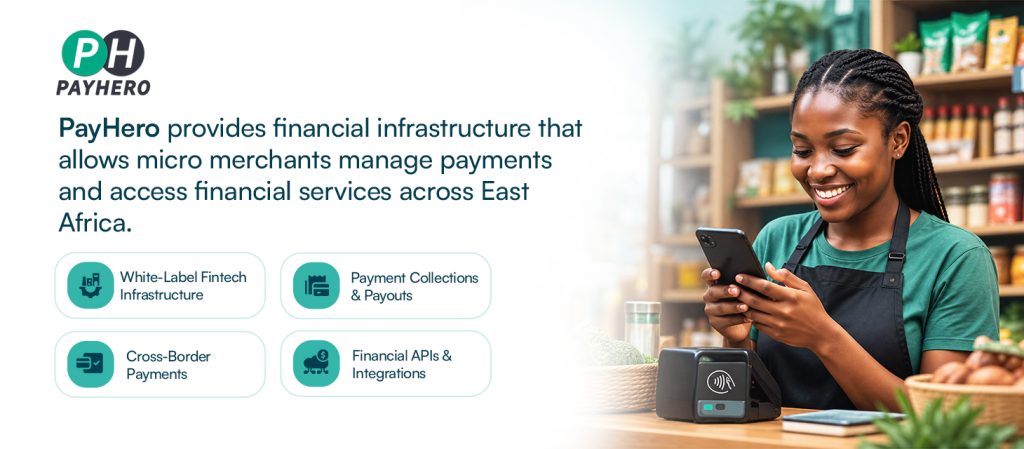
PayHero provides financial infrastructure that allows micro merchants manage payments and access financial services across East Africa. Its tools are available through multiple channels, such as WhatsApp, USSD, a web portal, and a mobile app, making its services accessible to merchants with different needs and preferences.
PayHero also offers white-label infrastructure for fintech companies looking to enter East African markets. The company is expanding its reach to countries such as Nigeria, South Africa, and Malawi.
As PayHero grows across different markets and payment use cases, flexible identity verification is an important part of supporting its operations and helping merchants transact with confidence.
The Challenge: Making KYC Work for Different Payment Needs
Before integrating Prembly into its core payment product, PayHero had worked with other identity verification providers. However, the available options presented challenges around pricing, flexibility, and the range of verification methods offered.
One major concern was the cost of verification. Previous providers charged approximately $3 per KYC check, making it difficult to justify full identity verification for low-value transactions, such as a $10 payment.
The second issue was that onboarding also needed to account for how different merchants interacted with PayHero. For merchants using WhatsApp, redirecting them to external onboarding pages could introduce friction and cause some users to drop off. A single onboarding process also could not address the differences in transaction values, customer contexts, and regulatory requirements across the Kenyan, Nigerian, and Tanzanian markets.
Additionally, verification options were limited, with providers primarily offering identity document checks and liveness verification. Other methods, including phone number and bank account verification, were either unavailable or charged separately.
For PayHero, the challenge was finding a verification partner that could offer more options at a suitable price while allowing the company to adapt its KYC requirements to different payment scenarios.
The Solution: Flexible KYC Verification With Prembly
PayHero began using Prembly for an NGO fundraising use case involving one-time cross-border payments. Following successful trials, the company moved to integrate Prembly into its core payment product
A key benefit is the ability for PayHero to match verification requirements to transaction values and risk considerations. For example, a lower-value transaction may require a phone number or national identification number match, while a higher-value transaction may need more comprehensive identity checks. This flexibility enables PayHero to determine the appropriate level of verification for different payment scenarios.
By supporting different verification approaches, Prembly helps PayHero move away from a one-size-fits-all model towards a better verification process that suits its merchants and market needs.
This flexibility is especially valuable to PayHero’s multi-channel infrastructure, where users may initiate transactions through WhatsApp, USSD, or other digital channels. The ability to adapt verification requirements can help the company support its users without unnecessarily disrupting their payment journeys
A More Flexible Approach to Payment Verification
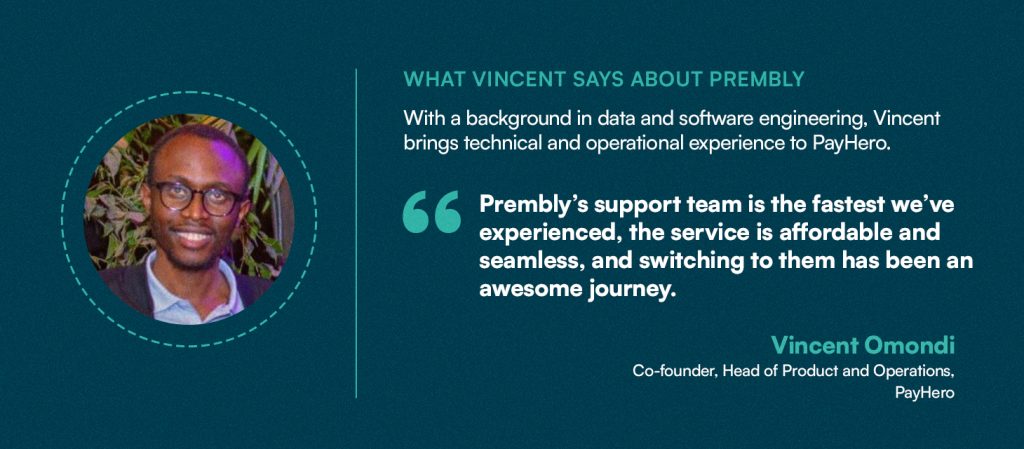
Since partnering with Prembly, PayHero has highlighted pricing, flexibility, and responsive support as positive aspects of the experience.
For a business serving micro merchants, verification costs need to be proportionate to the value of the transactions being processed. The ability to adjust verification requirements based on transaction amounts gives PayHero more room to support lower-value payments while applying more comprehensive checks where needed.
The company has also highlighted Prembly’s responsive support team as another benefit of the partnership. This support is particularly valuable as PayHero introduces verification into its core payment product and continues to develop its services across different markets. The early experience has encouraged PayHero to consider a broader adoption of Prembly, including its longer-term intention to migrate its full Kenya customer base as the business scales.
Through its work with Prembly, PayHero is moving towards a verification model that accounts for the varying transaction values, merchant needs, and market conditions associated with cross-border payments.